9 Articles, One Journey: What Have We Learned About AI? 🧭🤖
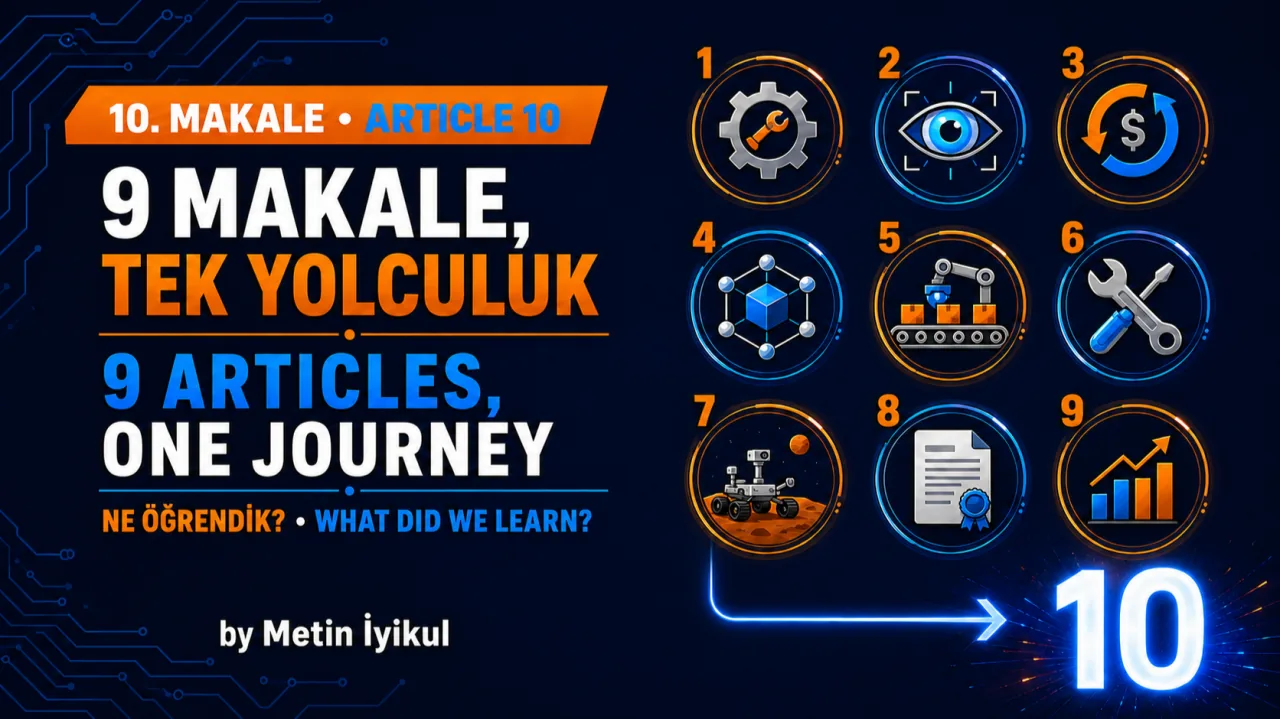
In article 10, we pause and look back at nine valuable lessons—from routine work to automation, and from automation to strategy.
This series started with a simple question: Do we really need to do the same tasks by hand every day? The first idea was not a technology show. It was a ‘magic button’ that could read a proforma invoice and prepare a bank instruction.
Then the journey became wider. We discussed vision, cost, model choice, pilot projects, building our own tools, autonomous robots in space, an Official Gazette desktop tool, and turning a learned method into decision support.
Now, in article 10, it is time to stop for a moment and look back. The nine articles covered different topics, but they asked the same question: How can we use AI to create real value in our work and life?
If you missed one or more articles, choose a title below and return to the earlier articles on my profile. Each one is valuable because each one explains a different problem and a different lesson.
🧭 Nine Articles, Nine Stops
🚀 1. From Routines to Automation
We made repeated work visible. The proforma-to-bank-instruction example taught us to start with pain, not with technology. First find the task that wastes time. Then map the steps and make the process simple enough to run with one click.
🧭 2. Vision Confusion: Who Is at the Wheel?
AI is a powerful engine, but it is not the steering wheel. People must choose the goal, the technology, the limits, and the original direction. AI can make operations faster, but human vision must lead.
🔁 3. The Infinite Loop: Assistant or Budget Monster?
Autonomy has hidden costs: tokens, repeated context, rate limits, and useless requests. The answer is a hybrid design. Normal software should watch for change. AI should run only when useful data arrives. Small jobs should use small models, and every loop should carry only the context it needs.
🧠 4. What Does a Billion Parameters Really Mean?
A bigger number does not always mean a better model. Parameter count shows capacity, not guaranteed quality. Data quality, active parameters, context size, speed, and total cost also matter. The best model is the one that works well on your own task and your own data.
🚧 5. Why AI Projects Stay in the Pilot Stage
A clean demo is not a live system. Production has bad data, exceptions, volume, and responsibility. To go live, a project needs end-to-end integration, a baseline, an owner, a recovery plan, and human approval for critical fields. A pilot shows possibility. Production shows sustainability.
🛠️ 6. Build Your Own Tool: Code Is No Longer the First Barrier
AI has shortened the distance between an idea and a working tool. A person who knows the process can build a prototype quickly. But building is not the same as maintaining. Error handling, logs, backups, documentation, security, and shared ownership are still human duties.
🚀 7. What Would an AI Robot Do on Mars?
On Mars, communication is slow, bandwidth is small, and there is no rescue team. Autonomy is not a trend there; it is an engineering need. Humans give the goal, while the robot plans the route, filters data, and handles surprises. Space teaches us to build AI that uses little power, works offline, explains decisions, and recovers from failure.
🏛️ 8. Do We Need to Remember the Official Gazette Every Morning?
The Official Gazette desktop tool joined the ideas from the series in one real product. It opens when the computer starts, brings the daily titles, filters them by keyword, and opens the full PDF. Good automation does not create another task to remember. It meets the user at the right time and completes the last step.
📈 9. If You Cannot Draw the Chart, Describe It to AI
AI can do more than automate office work. It can turn a concept we learned into an educational or decision-support tool. In the TradingView example, the key was not memorising every line of code. The key was defining what we wanted to see, the rule behind it, and where it could be wrong. The tool is not the decision.
🎯 Seven Lessons We Keep
1. Start with a real problem, not with new technology.
2. Keep the scope narrow, but solve it from start to finish.
3. Keep people at the wheel for goals, limits, approval, and responsibility.
4. Choose the right model, not the biggest model. Test with your own data.
5. Prepare for bad data and exceptions, not only for a clean demo.
6. Turn a working prototype into a process with owners, logs, backups, documentation, and security.
7. Give repeated work to machines. Keep judgement, learning, and strategy with people.
🔄 Missed an Article? This Is a Good Time to Go Back
The nine articles connect to each other. Automation leads to vision. Vision leads to cost. Cost leads to model choice. Model choice leads to production. Production leads to better tools and a better understanding of AI’s limits.
Choose the problem closest to your work and read that article again. Try to apply one idea to your own process. One good question can change a routine that has lasted for years.
🚀 Article 10 Is Not the End
This article is only a short pause. Across nine articles, we learned something more important than any single tool: ask the right question, see the limits, and connect AI to a real need.
The main message of the series is simple: AI is not magic by itself. The magic happens when a person who knows the process chooses the right problem and works with the right tool.
Which of the nine articles did you read? Which one did you miss? And what topic should article 11 cover? Let us discuss it in the comments.