Bringing a 15-Year-Old Machine Back to Life
Imagine a fifteen-year-old control board whose documentation has long been lost.
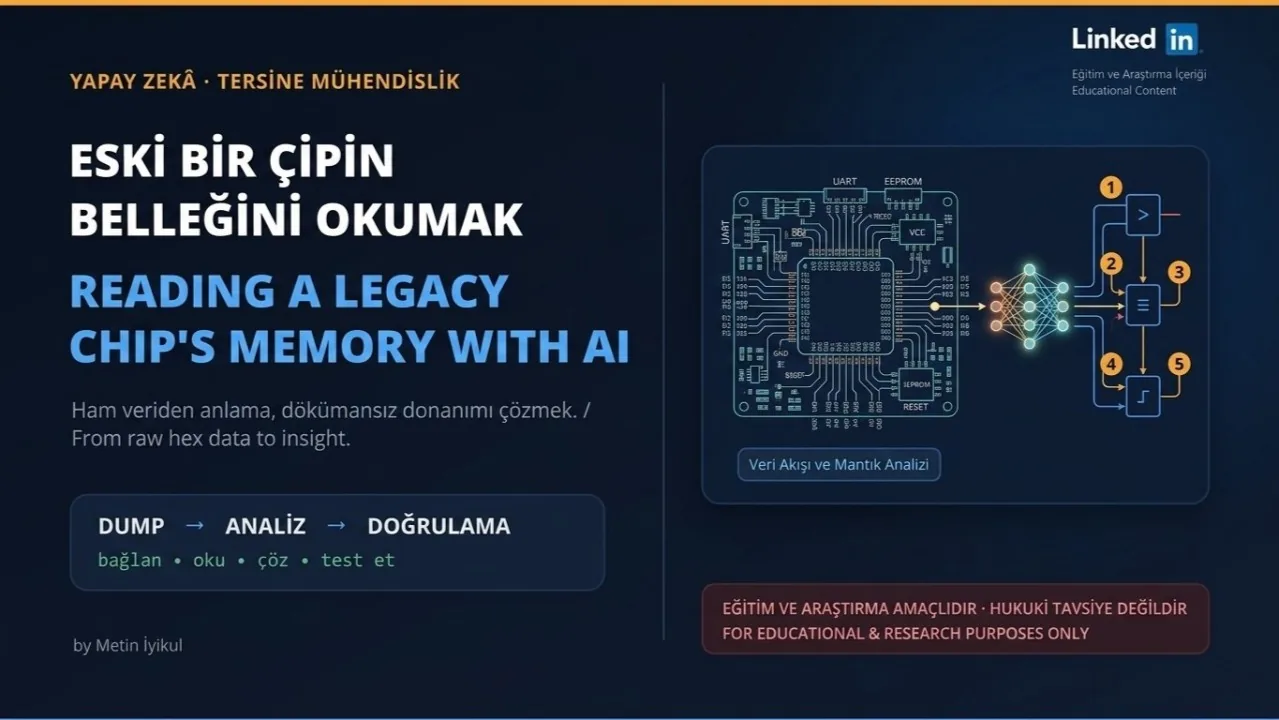
How AI is changing firmware reverse engineering
Imagine a fifteen-year-old control board whose documentation has long been lost.
In the past, when you dumped the memory of such a chip and were faced with thousands of lines of meaningless hex data, turning that raw data into something meaningful was a painstaking task that took weeks of patient work.
Today, feeding that exact same raw binary into an AI model can reduce this timeline from weeks down to hours or even minutes. The model recognizes patterns matching known microcontroller architectures, highlights bytes that likely indicate a checksum, a motor control block, or a voltage threshold, and presents the engineer with a testable hypothesis: "Look here first." The engineer still performs the final verification, but no longer walks in the dark. They now move with a guiding flare in hand.
1. Touching the Hardware: The Memory Dumping Process
Reverse engineering often starts with physical access. The method depends on the device and its protection system:
• Connect through UART, JTAG, SWD, ISP, or a suitable memory reader.
• Extract the firmware as a raw binary file without changing the device, when possible.
• Identify the processor family, memory map, instruction set, and file format.
• Study the binary with a disassembler, decompiler, string analysis, and controlled hardware tests.
Reliable data comes first. A wrong processor setting, byte order, or incomplete memory dump can send the whole analysis in the wrong direction.
2. The Role of AI: Extracting Meaning from Patterns
Large language models are no longer limited to human text; they can now analyze undocumented machine code as well. They act not as a mystic oracle, but as an intelligent assistant that accelerates an engineer's intuition:
• Comparing byte sequences against known hardware architectures and protocol patterns.
• Proposing functional blocks, checksum algorithms, and register maps as clear hypotheses.
• Surfacing clues within minutes that previously required weeks of trial and error.
Final verification still requires hardware testing, but the answer to "Where do I start?" now arrives in hours rather than weeks.
3. The Legal Aspect: Understanding is Allowed, What You Do with It Sets the Boundary
The legal landscape is just as crucial as the technical methodology and often overlooked. Something can be technically possible but legally restricted.
In intellectual property law (including Turkish Copyright Law / FSEK and global equivalents), computer programs and firmware are protected as copyrighted works. However, lawful owners hold fundamental rights:
• Under statutory fair use provisions, a lawful purchaser has the unalienable right to run the program, perform error correction, and create a single backup copy (rights that cannot be waived even by restrictive contracts).
• The law also grants a limited safe harbor for reverse engineering solely for system interoperability. However, knowledge gained cannot be used to build a competing clone or infringe upon IP rights.
• Commercial Secrets and Unfair Competition: Using extracted proprietary secrets to build rival products or disclosing them violates commercial trade secret laws and agreements.
Owning the physical device does not automatically make every action legal. Unauthorized access to another system, exposure of personal data, bypassing technical protection, or disclosure of confidential information may create separate legal risks.
In short: Analyzing a lawfully owned device for repair, understanding, or interoperability is one thing; commercializing or cloning that proprietary logic is an entirely different legal realm.
4. Future Vision: Reverse Engineering + AI
This synergy is far more than a nostalgic hobby:
• Industrial Sustainability: Extending the operational life of legacy factory equipment whose documentation is gone.
• System Transparency: Closed systems become transparent and manageable within lawful boundaries.
• Cyber and IoT Security: Security researchers can uncover critical vulnerabilities in legacy chips much faster.
Conclusion
Reverse engineering is no longer just about decoding the past. AI gives engineers a powerful new magnifying glass: making the internal logic of complex hardware visible within minutes, while keeping ultimate responsibility firmly in human hands.
LEGAL DISCLAIMER This article and its contents are provided strictly for EDUCATIONAL, RESEARCH, and INFORMATIONAL PURPOSES ONLY. Nothing herein constitutes legal, financial, or commercial advice. Reverse engineering practices are subject to national and international copyright laws (e.g., FSEK, DMCA, EU Directives) and contractual license terms. Readers are strongly advised to seek qualified legal counsel before conducting reverse engineering on proprietary or production hardware.