A New "Billion Parameters" Every Week: What Does That Number Actually Tell You? 🧠
In my last article, we discussed how token costs turn into a budget monster once you put AI into a loop, and I said model choice directly drives that cost. So what about the big number every launch puts front and center?
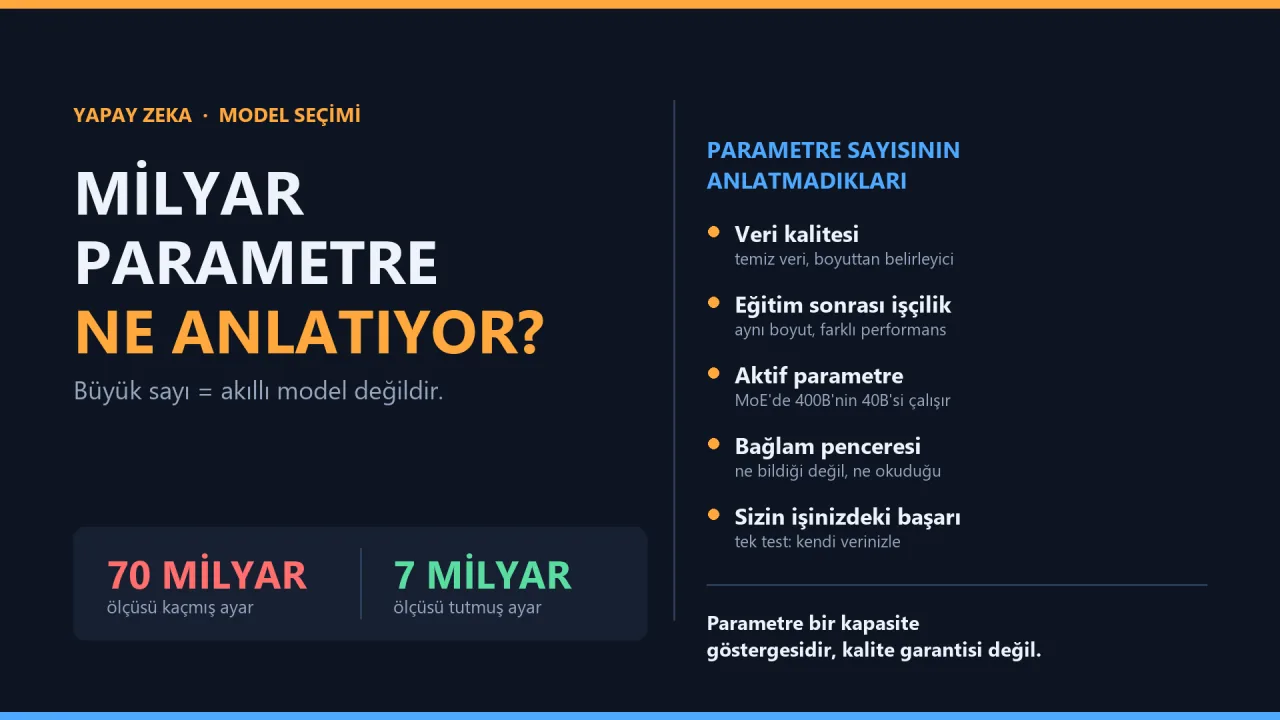
"7 billion parameters", "70B", "405B", "1 trillion"... Every week a new model arrives and the headline is always the same metric, as if a bigger number automatically meant a smarter AI.
From the field, I can say this plainly: parameter count is an indicator of capacity, not a guarantee of quality.
🔍 What Is a Parameter, Really?
Parameters are the adjustable values a model learns during training. Think of the settings in a kitchen: how much salt, the ratio of spices, the heat of the stove, the cooking time. A dish might have 10 settings; a model has 7 billion. Training is the process of getting each one to the right point.
Two simple conclusions follow:
· More settings = more capacity to store knowledge and capture complex patterns.
· But the number of settings doesn't mean they are set right. With the same ingredients, 70 billion badly measured settings produce a worse dish than 7 billion well measured ones.
⚠️ 5 Things Parameter Count Does NOT Tell You
1. Data quality. Intelligence depends more on the quality and volume of training data than on raw size. Beyond a point, training on more and cleaner data beats simply making the model bigger. The small-but-surprisingly-strong models of recent years are the proof.
2. Post-training craft. What makes a model useful comes after pre-training: instruction tuning, alignment with human feedback, reasoning training. Two models of identical size can perform worlds apart because of this.
3. How many parameters actually fire. Many modern models use MoE (Mixture of Experts). A model may hold 400B parameters but activate only 30-40B per query. "Total" and "active" parameters are different numbers, and it's the second one that drives cost and speed. Guess which one goes in the announcement.
4. The context window. Parameters are what the model knows; the context window is how much it can read at once. These two get confused constantly. If you're analyzing a 200-page contract, context is your metric, not parameters.
5. Success on YOUR task. The model that tops general benchmarks may lose to the runner-up on your invoice parsing or document classification workflow. The only benchmark that counts is the one run on your own data.
💸 The Part That Hits the Invoice
Size means cost: more compute, more memory, higher token prices, slower responses. Recall the loop scenario from my previous article, a job running every 5 minutes. Picking "the biggest model" there shows up as a surprise bill at the end of the month.
And for most operational tasks (classification, extraction, yes/no decisions, reformatting) a small model is already more than enough. Save the heavy artillery for the stages that genuinely need deep reasoning; your budget and your latency will both thank you.
✅ So What Should You Look At?
1️⃣ Task difficulty. If the question is "which number here is the tax ID?", you don't need a giant.
2️⃣ Active parameters and latency. When a user is waiting on screen, speed beats a couple of accuracy points.
3️⃣ Your context needs. Processing long documents? That's your criterion.
4️⃣ Build your own test set. Take 20-30 real examples and run every candidate through them. Half a day of work buys you months on the right model.
5️⃣ Compute cost monthly. A single request looks cheap; multiply it by 5,000 requests a day to see reality.
🎯 Final Word
Parameter count is like engine displacement. It tells you something, but it doesn't tell you the car is good. The transmission, the weight, the handling and above all where you'll drive it matter just as much.
Which brings me back to my article on vision: the human should choose the technology. Picking the biggest number on the marketing page isn't a strategy. Measuring what your business needs and choosing accordingly is.